Shoulder pain is one of the most common reasons people seek help for a musculoskeletal problem. It can affect anyone, from office workers who spend hours at a keyboard to tradies working overhead, swimmers, gym-goers and retirees who enjoy gardening. In many cases the rotator cuff is involved. This group of four muscles and their tendons keeps the ball of your shoulder centred in its socket and allows you to lift, reach and rotate your arm.
The good news is that most rotator cuff problems respond well to the right exercise program, often without the need for surgery.
Why Exercise Works
It’s tempting to rest completely when your shoulder hurts, but long periods of inactivity often backfire. The joint becomes stiff, the muscles weaken, and everyday tasks start to feel harder and more painful.
Targeted exercise helps in several ways:
- It restores range of motion and reduces stiffness.
- It strengthens the rotator cuff and the muscles around the shoulder blade, so the joint is better supported.
- It improves blood flow to the tendons, supporting healing.
- It gradually rebuilds your tolerance for the activities you want to return to.
Research consistently shows that supervised exercise programs can produce outcomes comparable to surgery for many rotator cuff conditions, particularly tendinopathy and partial tears.
What Is a Rotator Cuff Injury ?
The rotator cuff can become painful in several ways:
- Tendinopathy: The tendons become irritated or overloaded, usually from repetitive activity or a sudden increase in workload.
- Partial tears: Some fibres of the tendon are damaged, often through gradual wear or a minor strain.
- Full-thickness tears: The tendon is torn through, usually after a significant injury or long-standing degeneration.
- Impingement-type pain: Tendons and soft tissue become pinched or irritated during overhead movements.
Typical symptoms include a dull ache deep in the shoulder, pain when lifting your arm, difficulty sleeping on the affected side, and weakness when reaching behind you or overhead.
Exercises to Help Shoulder Pain
1. Pendulum swings
Lean forward with one hand supported on a table and let your affected arm hang. Gently swing it in small circles, letting gravity do the work. This eases stiffness without loading the joint. Try 30-60 seconds each direction.
2. Cross-body stretch
Bring your affected arm across your chest and use your other hand to hold it in place. Hold for 20-30 seconds and repeat 2-3 times. This stretches the back of the shoulder.
3. Scapular squeezes
Sit or stand tall and gently draw your shoulder blades back and down, as if tucking them into your back pockets. Hold for 5 seconds and repeat 10 times. Good shoulder blade control takes pressure off the rotator cuff.
4. External rotation with a resistance band
Tie a light band to a door handle and hold the other end with your elbow tucked at your side, bent to 90 degrees. Slowly rotate your forearm outward, then return with control. Aim for 2-3 sets of 10-15 repetitions. This directly strengthens the rotator cuff.
5. Internal rotation with a resistance band
Reverse the movement, rotating your forearm inward across your body against the band. This balances strength in the shoulder.
6. Wall slides
Place your forearms on a wall and slide them upward as far as is comfortable, keeping your shoulders relaxed. This builds overhead control gradually.
7. Side-lying external rotation
Lie on your good side with a small towel under your elbow and a light weight in your hand. Lift your forearm toward the ceiling, then lower slowly. It’s an excellent exercise for building rotator cuff strength safely.
How to Progress Safely
- Start gently. Begin with mobility and light activation before adding resistance.
- Respect your pain. Mild discomfort during exercise is usually acceptable, but sharp, intense or worsening pain is a signal to stop and modify.
- Be consistent. Short sessions most days are more effective than occasional hard sessions.
- Increase load gradually. Add repetitions, resistance or range of motion slowly over weeks.
- Look at the bigger picture. Posture, workstation setup, sleeping position and training habits all influence shoulder health.
Common Mistakes to Avoid
- Stopping exercises as soon as the pain eases, which often leads to recurrence.
- Pushing through sharp pain in the hope of speeding things up.
- Focusing only on stretching without building strength.
- Ignoring the shoulder blade and upper back muscles.
When to Seek Help
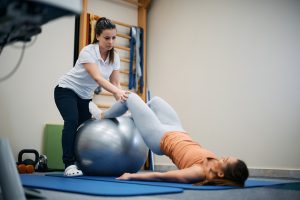
See a healthcare professional if your shoulder pain follows a fall or significant injury, wakes you at night, causes marked weakness, or hasn’t improved after a few weeks. An exercise physiologist can assess your movement, identify what’s driving your symptoms and build a program matched to your goals.
Get Help With Your Shoulder Pain in Brisbane South
At JY Exercise Physiology in Upper Mount Gravatt, Brisbane South, we specialise in evidence-based exercise programs for injury rehabilitation, chronic pain management, and general workplace wellness for all ages and abilities. Whether you have been dealing with shoulder pain for weeks or years, we are here to help you get back to doing what you love.
 147 Lumley Street, Upper Mount Gravatt QLD 4122, also offering home visits across Brisbane South including Sunnybank, MacGregor, Wishart, Runcorn, Eight Mile Plains and Surrounding areas.
 Call or text: 0421 967 711
 Email: admin@jyexercisephysiology.com
Learn more here: Injury Rehabilitation
Medicare CDM, NDIS, DVA, WorkCover QLD, Private Health and Other Insurances accepted. No referral required for private clients.